


What is Cosmeticorexia?
As a Beauty Editor, mum and also someone who has mentored teenagers throughout my 27-year career, there is no doubt that I am alarmed with the the skincare industry’s current obsession with under-18 consumers. But sadly, I'm not surprised. And now, it even has a name…
‘Cosmeticorexia’ has been making headlines. It has become the industry’s newest buzzword to describe the obsession that teenagers and children have about their skincare routines. An obsession that often sees them using inappropriate products that are not meant for their young, fresh and healthy complexions.
What is the truth about Cosmeticorexia? After 27 years in the industry, I've found it's not simply an "obsession," but a search for agency. While the media focuses on the $698B industry’s influence, The Beauty Ed® THE LAB, my proprietary mentoring group for Gen A and Gen Z students, has identified that for many teens, their skincare ‘obsession’ is actually a search for control and wellbeing rather than anti-ageing.
So while the “cosmeticorexia” headlines are busy panicking, they are missing the most important part of the story: the teenagers’ own perspective. And if we understand what is really going on from their point of view, I think that the industry - and the media - will realise that they need to give these cosmeticorexia "victims" a lot more credit.
Realities from THE LAB: They Seek Control Not Correction
While headlines paint a picture of children blindly following influencers into a “retinol trap,” the voices from THE LAB tell a different story. One of intentionality. For 14 year old Lexie, a multi-step routine is a foundational anchor to help her start her day.
They Seek Control & Self-Care In Their Skincare Routine
“My friends and I talk about waking up forty-five minutes early to do a multi-step skincare routine to limit acne and protect our skin barrier. Skincare is important to me because I feel that my skin is something that I can control.”
Lexie’s point of view is echoed by Donyae, 17, who uses her routine as a mental health tool: “It was one of the first ways I learned to care for myself. My routine gives me time to reflect, check in with myself, and appreciate my growth, personally and in my skin journey.”
THE LAB students prove that the “Sephora Kid” stereotype often misses the mark too:
The industry often assumes these kids are impulsive, but Kira proves the stereotype misses the mark on trust: “I often buy brands that work for my mom or sisters... I tend to not trust social media for recommendations since I find them distrusting most of the time.”
Similarly, Donyae completely upends the “Sephora Kid” stereotype of impulsive buying: “For skincare, I trust myself the most. I research ingredients, pay attention to my skin’s history, and introduce products slowly. I would much rather listen to my skin than hop on the bandwagon.”
Even Mauricio, the only male in THE LAB, views it through a lens of simple hygiene rather than cosmetic vanity: “I view skincare as very important to hygiene... I still like to keep it simple.”
A Call for “Whimsy” in a $698 Billion World
Perhaps Gen A’s most damning evidence against the industry’s “Cosmeticorexia” marketing spin comes from high school Junior Ana, who highlights exactly what the industry has stripped away: Fun.
“I hope to see more emphasis on bringing the fun and whimsy back to beauty,” Ana says. “I really want to make the whole idea of beauty less serious and more focused on what you want to do with yourself.”
Despite having skin struggles that required a clinical approach - using a mix of organic skincare like Eminence, a simple Dove bar, and Tretinoin - Ana’s perspective remains grounded in self-care rather than self-correction. To her, beauty is simply “spending time with yourself... in order to prepare yourself for the day.”
The Industry Pivot: Are Brands Finally Listening To Gen A?
Thankfully, some corners of the industry are beginning to pivot away from ‘collagen banking’ and toward the age-appropriate care that THE LAB mentees are calling for. We are seeing a new wave of brands that focus on ‘barrier-first’ beauty rather than ‘active-heavy’ correction.
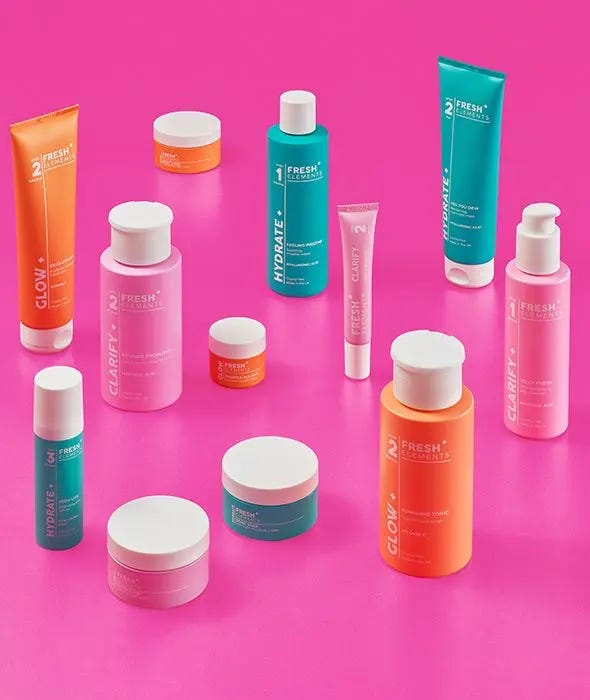
Take Marks & Spencer, for example. They’ve just launched Fresh Elements, a range specifically designed for the 12+ demographic. With prices starting at £9.50, it offers the ‘shelfie-worthy’ aesthetic teens want, but with dermatologically approved, gentle formulas that focus on hydration rather than harsh acids. It’s a direct answer to parents who want to give their kids the ritual without the risk.
We are also seeing the rise of ‘founder-led’ transparency with indu, now a fast-growing teen favorite at Sephora. What makes indu different is that it was built alongside a teen committee - much like my own work with THE LAB - to ensure the products actually support the skin’s microbiome rather than overwhelming it.

And then there is the highly anticipated HIKU by Harper (Beckham). While any Beckham-backed launch will inevitably cause a stir, the focus here is reportedly on K-Beauty influences - a category known for its ‘skin-first’ philosophy, lightweight textures, and playful presentation. If Harper leans into not just the education, but also the ‘whimsy’ that Ana from THE LAB craves, it could set a new, healthier standard for celebrity-led teen beauty.
The Skincare Industry’s Missing Link For Gen A
As Gen Xers, our Saturday afternoons spent in The Body Shop were defined by a curiosity that ended at the tester pots. But we didn't buy the Eldeflower Eye Gels because we knew we didn't need them. Today, that "need" is being manufactured by an industry projected to hit $698.38 BILLION by 2026.
But as my mentees at THE LAB prove, you cannot manufacture authenticity and this generation is doing the work that many brands are failing to do: they are listening to their skin.
The beauty industry needs to stop treating Gen Alpha as “fodder” for the next trending headline and start treating them as the researchers they are. And if they want to solve the “Cosmeticorexia” crisis, the solution isn’t giving them more products - it’s giving them more credit.
A Beauty Editor and Gen A Mentor’s Perspective
In the world of beauty journalism, we often fall into the trap of looking at a trend from just one angle, and right now, ‘Cosmeticorexia’ is being viewed through three very loud lenses: the “panicked parents”, the “click-hungry” media and the “revenue hungry'“ brands.
Yes, we’ve heard the horror stories of ten-year-olds demanding Retinol, and we’ve seen the industry reports on the $698 billion gold mine, but if my 27 years in this industry have taught me anything, it’s that you can’t understand the headlines if you ignore the main protagonists.
That is why I started THE LAB. My mentees aren’t just a ‘demographic’ or a ‘slice of the pie’ - they are the ones living the story. And the reality I see is they are a generation searching for a bit of fun, a bit of control, and a lot of ‘whimsy’ in a world that has become far too serious for their young minds.
So in my opinion, if we want to solve the ‘Cosmeticorexia’ crisis, we have to stop talking about these kids as if they are helpless victims and start giving them the credit they deserve. They are the researchers, the ones with the curious minds, and the ones who will ultimately decide if the industry’s obsession with them is on the right course.